

Working Capital Loan Malaysia: How to Survive Slow Months, Late Payments & Cash Crunches
Nearly 30% of Malaysian SMEs still manage their finances manually. About 70% hold less than six months of cash reserves. [1] Poor cash flow, not weak products or strong competitors, is one of the main reasons profitable businesses fail.
A working capital loan is money set aside for exactly this gap. It helps cover expenses before customer payments arrive, whether cash is tied up in unpaid invoices, unsold inventory, or late payments.
For example, a Shopee seller may need to restock before a major sale, a contractor may wait 60 to 90 days for client payment, and a car workshop owner must cover inventory and payroll before receiving the next round of customer payments. Each of these is a working capital problem, not a business failure.
This guide explains what a working capital loan is, when your business needs one, the financing options available in Malaysia in 2026, and how to apply step by step. It closes with practical habits that help a business borrow less over time.
What Is a Working Capital Loan? (And How It Differs from Other Business Loans)
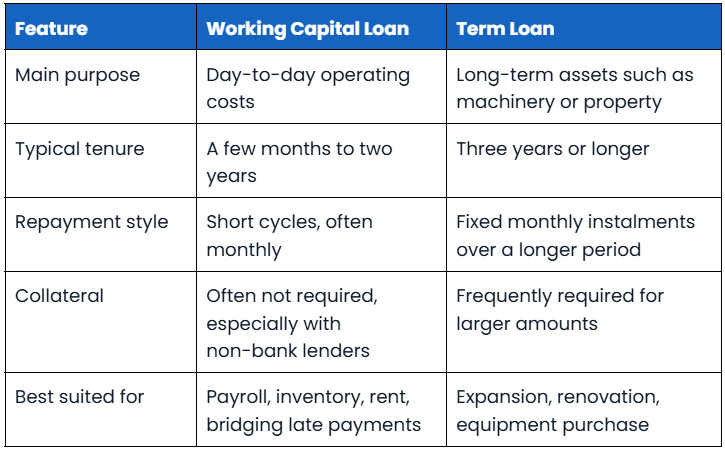
A working capital loan is financing used to cover a business's day-to-day operating costs. That includes payroll, rent, utilities, inventory, and short-term supplier obligations. It is not intended to fund business expansion, renovations, or heavy equipment purchases. Those goals usually call for a term loan instead.
Working Capital Loan vs Term Loan: Key Differences
What Can You Use It For? (Payroll, Inventory, Rent, Marketing)
- Paying staff salaries and EPF or SOCSO contributions on schedule
- Restocking inventory ahead of a busy season or a large order
- Covering rent, utilities, and other fixed monthly costs
- Funding short-term marketing pushes around festive periods
- Bridging the gap while waiting on a client's payment
In the “Client Success” section, you can see examples of how SME owners have actually used the funds.
5 Signs Your Malaysian Business Urgently Needs a Working Capital Loan
1. You Are Struggling to Pay Staff Salaries or Supplier Invoices on Time
When payroll day feels stressful every month, that is not a staffing problem. It is a cash flow problem. The same applies when supplier invoices start slipping past their due dates. A working capital loan exists to close that gap before it damages staff morale or supplier relationships.
2. Your Customers Owe You Money for 30, 60 or 90+ Days
Businesses that supply corporate clients or government-linked companies often deal with long payment terms. A contractor, service provider, or wholesaler can have a full order book but still face cash flow problems because customer payments have not yet been received.
3. Ramadan, Hari Raya or Year-End Sales Are Draining Your Stock Budget
F&B outlets, retail shops, and online sellers on platforms such as Shopee and Lazada all face the same seasonal squeeze. Businesses often need to purchase inventory weeks before Hari Raya, Chinese New Year, or year-end sales generate revenue. That upfront spending can strain even a healthy business.
4. You Are Turning Down New Orders Because You Cannot Afford the Inventory
This is one of the clearest signs of a working capital shortage. A growing business may lose new sales opportunities because it cannot afford inventory or materials upfront. A short-term working capital loan can bridge that funding gap.
5. Your Business Emergency Fund Has Run Completely Dry
A slow month, a broken piece of equipment, or a late-paying client should not threaten a business's survival. When cash reserves are depleted, it may be time to consider business financing before unexpected expenses create cash flow problems.
Working Capital Loan Options for Malaysian SMEs
Malaysian SMEs generally have four main paths to working capital financing. The right financing option depends on how quickly you need funds, whether you have collateral, and your business's financial history.
Bank Overdraft & Revolving Credit Facilities
An overdraft or revolving credit line lets a business draw funds up to an approved limit and pay interest only on the amount used. Pricing at Malaysian banks is generally set with reference to Bank Negara Malaysia's Overnight Policy Rate, which stood at 2.75% as of the central bank's May 2026 decision. [2] Bank overdrafts are a flexible financing option for established businesses, but approval depends on documentation, collateral, and the bank's credit assessment.
Invoice Financing: Get Paid Before Your Client Pays You
Invoice financing lets a business convert unpaid invoices into cash. Invoice financing allows businesses to receive an advance on unpaid invoices, with the remaining balance released after customer payment, minus applicable fees. [3] It is ideal for businesses with corporate customers on long payment terms, as the invoices serve as collateral instead of property or other fixed assets.
Trade Finance: Best for Import/Export Businesses
Trade finance helps importers and exporters manage cash flow when purchasing inventory or trading internationally. Common trade finance solutions include letters of credit (LCs) and trust receipts. Some trade finance facilities may also qualify for Government Guarantee Schemes administered by Syarikat Jaminan Pembiayaan Perniagaan Berhad (SJPP), including the Working Capital Guarantee Scheme (WCGS), subject to the participating bank and facility terms.[4]
Non-Bank Working Capital Loans: FundingBee
Non-bank lenders help Malaysian SMEs access business financing when they cannot meet bank collateral or credit requirements. FundingBee, operated by Bee Informatica Sdn Bhd and licensed by KPKT (Licence No. WL7517), offers collateral-free business financing from RM5,000 to RM50,000.
Applications go through a fast approval process rather than the paperwork-heavy assessments typical of traditional banks.
Collateral-free business financing is suitable for businesses that need fast access to funds but do not have assets to pledge, subject to the lender's credit assessment. Comparing eligibility, interest rates, and loan terms across multiple lenders can help businesses find the most suitable financing option.
How to Apply for a Working Capital Loan in Malaysia (Step by Step)
Simple Eligibility Requirements
Requirements vary by lender, so there is no universal checklist. Most lenders require businesses to be registered with the Companies Commission of Malaysia (SSM) and submit documents such as recent bank statements, financial statements or management accounts, and identification for business owners or directors. Businesses with a longer operating history generally have more financing options. The exact criteria always depend on the individual financial institution, so it is worth checking directly before applying.
Documents You Will Need
- Copy of SSM business registration (Form 9, 24, 49 or the equivalent)
- IC or passport copy of the business owner or directors
- Recent bank statements, typically the last three to six months
- Financial statements or management accounts, where available
Lenders may also review a business owner's CTOS credit score as part of the assessment. Preparing complete and accurate documents upfront is the single biggest factor in speeding up approval.
Application Timeline: From Submission to Disbursement
FundingBee can assess applications and disburse funds within a few business days, provided all required documents are submitted. Traditional banks and financial institutions typically have longer loan approval times because of documentation requirements, collateral, and credit assessments.
Smart Tips to Manage Your Working Capital Better (So You Borrow Less)
Negotiate Better Payment Terms with Your Suppliers
Suppliers may offer more flexible payment terms or early payment discounts, especially for businesses with strong supplier relationships or consistent order volumes. While not guaranteed, these negotiations can be an effective way to improve short-term cash flow without external financing.
Use a Simple Cash Flow Forecast Template to Plan Ahead
A weekly or monthly cash flow forecast helps businesses identify cash shortages before they happen. Even a simple spreadsheet can improve cash flow planning. As Malaysia's LHDN e-Invoicing rollout continues in 2026, businesses can use invoice data to support tax compliance while improving cash flow forecasting. [5]
Review your cash flow forecast and bank balances every month to improve cash flow management and avoid financial surprises.
Fumiko, CEO of FundingBee, also explains how to manage cash flow in this article.
Why FundingBee Is Malaysia's Most Trusted Working Capital Partner
For SME owners who need fast, collateral-free business financing, FundingBee offers three key benefits: no collateral, minimal paperwork, and fast approval.
Fast Approval, Funds Disbursed Quickly
FundingBee offers a fast approval process designed for SME owners who need financing decisions within a few business days. The fully digital application process allows for faster processing than traditional bank loans.
No Collateral Required, Minimal Paperwork
Financing from RM5,000 to RM50,000 is available without collateral such as property or fixed assets. A one-time processing fee applies to approved financing, with all charges clearly disclosed upfront.
Conclusion
A slow month, a late-paying client, or a seasonal order should not put a healthy Malaysian SME at risk. Working capital financing helps bridge cash flow gaps through options such as bank overdrafts, invoice financing, trade finance, and fast, collateral-free business loans from licensed non-bank lenders like FundingBee.
The right option depends on how quickly a business needs funds, whether it has collateral to offer, and how established it is. SME owners in the F&B, retail, automotive, and service industries who need fast, collateral-free business financing may find FundingBee a suitable option, subject to eligibility.
Apply for a Working Capital Loan: Get Funded Fast with FundingBee
References
[1] SME Association of Malaysia (Samenta), 2025/26 SME Outlook Survey, as reported by Free Malaysia Today, 7 October 2025. https://www.freemalaysiatoday.com/category/nation/2025/10/07/sme-groups-urge-digitalisation-financing-support-in-budget-2026
[2] Bank Negara Malaysia, Monetary Policy Statement, 7 May 2026. https://www.bnm.gov.my/-/monetary-policy-statement-07052026
[3] Investopedia, Invoice Financing: Definition, Structure, and Benefits. https://www.investopedia.com/terms/i/invoice-financing.asp
[4] Working Capital Guarantee Scheme (WCGS)
https://sjpp.com.my/schemes/working-capital-guarantee-scheme-wcgs/wcgs
[5] Lembaga Hasil Dalam Negeri Malaysia (LHDN / HASiL), e-Invoice Implementation Timeline. https://www.hasil.gov.my/en/e-invoice/implementation-of-e-invoicing-in-malaysia/e-invoice-implementation-timeline/

.jpeg)