
SME Loan Malaysia: Complete Guide to Rates, Requirements & Financing Options

An SME loan is a form of business financing that helps small and medium-sized enterprises meet their financial needs. Businesses may use financing for working capital, inventory, equipment, payroll, expansion, or other business expenses.
In Malaysia, SMEs can access financing through different channels, including banks, government-backed financing programmes, development financial institutions, peer-to-peer (P2P) financing platforms, and other non-bank lenders. Eligibility requirements, financing amounts, rates, and repayment terms can vary by lender and financing product. (1)
This guide explains what you need to know about SME loans in Malaysia, including eligibility, interest rates, loan types, required documents, how to apply, and the financing options available to your business.
1. What Is an SME Loan in Malaysia?
An SME loan provides financial support to small and medium-sized enterprises in Malaysia to cover various operational needs. While commercial and Islamic banks remain the primary source of SME financing, government-backed programs and alternative financing options are also available.(1)
Depending on your business goals, you can choose between short-term financing (to bridge temporary cash flow gaps or manage working capital) and long-term financing (for equipment, renovation, or expansion).
What Can an SME Loan Be Used For?
Permitted fund uses vary by product, with some financing tailored specifically for working capital and others designated for capital expenditure. Common legitimate business purposes include:
- Working capital – Covering daily operational expenses and payroll
- Inventory & Stock – Purchasing raw materials or products
- Equipment and Machinery – Upgrading or buying essential business tools
- Renovation & Expansion –Fitting out premises or growing ingo new locations
- Cash Flow Management– Bridging short-term gaps between income and expenses
2. Who Qualifies as an SME in Malaysia?
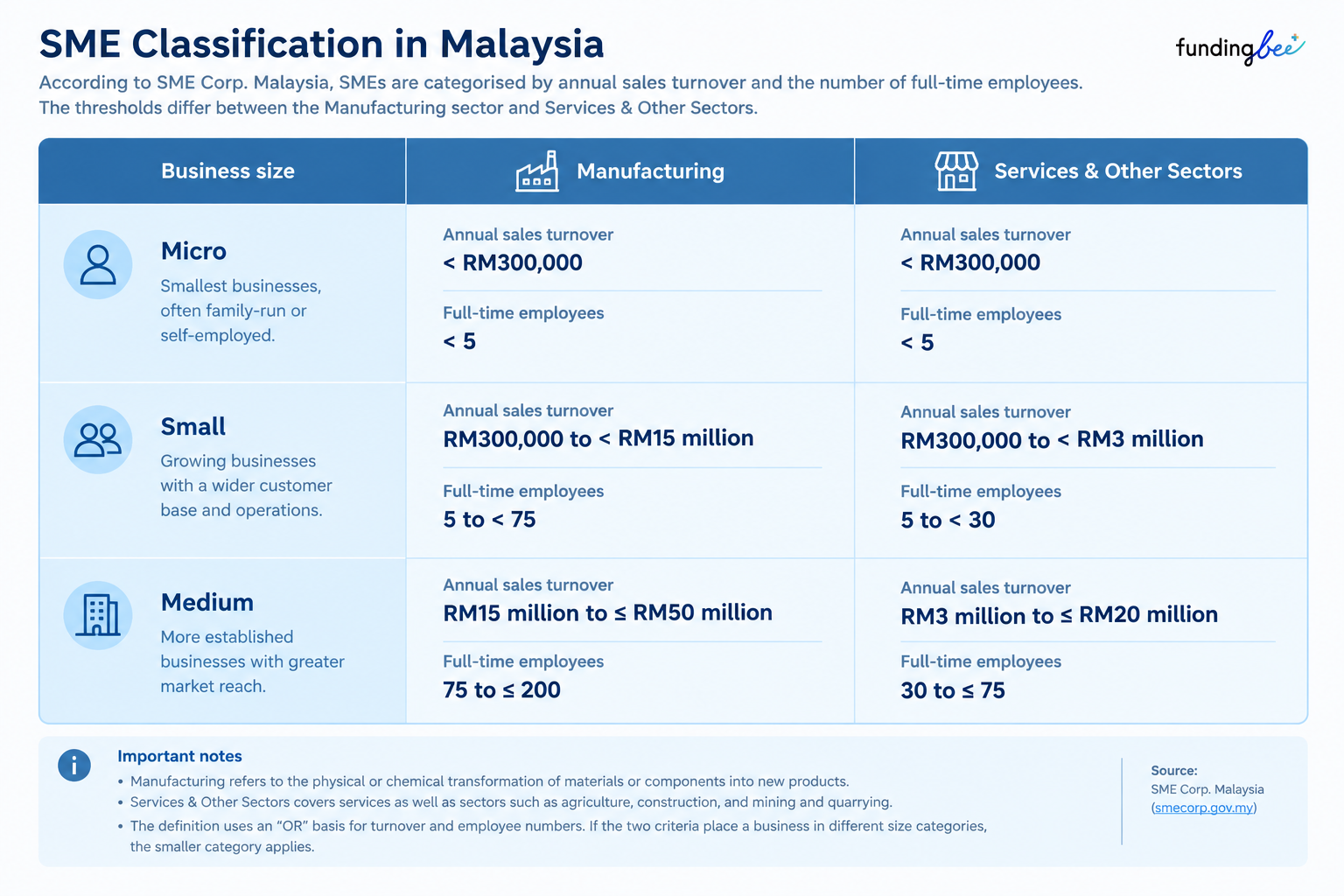
In Malaysia, SME Corp. Malaysia defines a small and medium enterprise (SME) based on two criteria: annual sales turnover and the number of full-time employees. The thresholds differ between the Manufacturing sector and Services & Other Sectors. (3)
According to SME Corp. Malaysia's current SME definition, microenterprises across all sectors have annual sales turnover of less than RM300,000 or fewer than 5 full-time employees. The thresholds for small and medium enterprises vary by sector:
SME Corp. Malaysia defines Manufacturing as the physical or chemical transformation of materials or components into new products. Services & Other Sectors covers services as well as sectors such as agriculture, construction, and mining and quarrying. (3)
The definition uses an “OR” basis for turnover and employee numbers. If the two criteria place a business in different size categories, the smaller category applies. For example, a business with turnover in the small-enterprise range but fewer than 5 full-time employees would be classified as a microenterprise.
Meeting SME Corp. Malaysia's definition means that your business falls within the national SME classification. It does not automatically mean that you will qualify for or be approved for SME financing.
Loan and financing eligibility can vary by lender, financing product, business activity, operating history, financial position, credit profile, and other requirements.
Therefore, once you have established that your business is an SME, the next step is to look at the specific financing options available and check their individual requirements.
3. Types of SME Loans in Malaysia

SMEs in Malaysia can access different types of financing depending on how they will use the funds, how long they need them, and the financing provider.
Some options support day-to-day cash flow, while others suit long-term investment or business growth. Requirements, amounts, costs, and repayment terms vary by lender and product.
Term Loans
A term loan is a common form of business financing where a business receives a fixed amount and repays it over an agreed period.
It can be suitable for longer-term expenses such as:
- Equipment and machinery
- Business premises renovation
- Opening a new location
- Business expansion
The financing amount, tenure, rate, collateral requirements, and repayment structure depend on the lender and product.
Working Capital Loans
Working capital financing helps businesses manage day-to-day operating expenses and temporary cash flow gaps.
It may be used for:
- Inventory or raw materials
- Supplier payments
- Payroll and operating expenses
- Short-term cash flow needs
Some government-backed facilities are also designed specifically to support SME working capital. BNM's SME financing facilities, for example, include programmes channelled through participating financial institutions. (1)
The key is to compare total financing cost, repayment terms, eligibility requirements, and documentation rather than assuming one type of provider is automatically better.
4. SME Loan Comparison in Malaysia

Approval speed: Approval times vary by lender and product. Bank and government-backed financing may take longer because of detailed credit assessments, while some microfinance and non-bank options can make decisions faster. P2P financing also depends on how quickly the funding can be found.
Interest rate: Rates and profit rates vary significantly by financing type, lender, and borrower. Government-backed and microfinance programmes may offer relatively lower rates, while alternative financing can have different pricing based on risk and terms. Compare the total financing cost, not just the headline rate.
Documents: Banks generally require more detailed financial and business documents. Government-backed and microfinance programmes have scheme-specific requirements, while some non-bank providers may use a simpler application process. Always check the exact document requirements before applying.
5. SME Loan Interest Rates in Malaysia
SME loan interest rates in Malaysia can vary depending on the financial institution, financing product, business profile, and facility terms.
When comparing SME financing, look beyond the advertised rate. The way the rate is calculated, the repayment period, fees, and whether the rate is based on a flat or reducing balance can all affect the actual cost of financing.
Flat Rate vs Reducing Balance Rate
A flat rate is calculated based on the original principal amount throughout the financing period. The repayment amount may therefore remain consistent even as the outstanding balance decreases.
A reducing balance rate is calculated based on the outstanding principal. As the principal is repaid, the amount on which the rate is calculated decreases.
Because these methods can produce different total financing costs even when the quoted rates appear similar, businesses should compare the total repayment amount rather than looking at the stated rate alone.
For a more detailed explanation and an estimate of your potential repayments, see our business loan calculator.
What Affects SME Loan Interest Rates?
Lenders may consider several factors when determining the rate and terms offered to a business. These can include:
- Business history – how long the business has been operating
- Revenue – the scale and consistency of business income
- Cash flow – whether the business generates sufficient cash to meet repayments
- Credit profile – the business and, where relevant, owner's credit history
- Loan amount – the amount being requested
- Loan tenure – how long the financing will be repaid
- Collateral – whether assets or other security are provided
- Financing provider – different banks, government-backed programmes, and non-bank providers have different pricing models and risk criteria
This means that two businesses applying for similar amounts may receive different rates or financing terms.
When comparing options, consider the overall cost of financing, repayment structure, fees, and affordability, rather than choosing an SME loan based on the lowest advertised rate alone.
6. SME Loan Eligibility & Requirements

Being classified as an SME does not automatically mean that your business will qualify for financing. Lenders and financing providers assess applications based on their own criteria, which can include the business structure, operating history, revenue, cash flow, and credit history.
Business Registration
Many SME financing products require the business to be formally registered. In Malaysia, businesses can be registered with the Companies Commission of Malaysia (SSM) as a sole proprietorship, partnership, company, or other recognised business entity. (6)
The exact registration requirements for financing depend on the lender and product. Some programmes may be available to sole proprietors and partnerships, while others may target companies or specific types of businesses.
Years in Business
There is no universal minimum operating period for all SME loans in Malaysia.
Some lenders and financing programmes may require a business to have operated for a certain period, while others may be designed specifically for newer businesses or microenterprises. The requirement can therefore vary depending on the lender, financing product, and purpose.
Rather than assuming an SME must have operated for a specific number of years, check the eligibility criteria for the financing option you are considering.
Revenue & Cash Flow
Lenders generally need to assess whether a business has sufficient financial capacity to repay the financing. Depending on the product, they may review information such as:
- Business revenue and financial performance
- Bank transaction history
- Existing loans and financial commitments
- Cash flow
- Repayment capacity
For example, BNM-backed financing programmes are still subject to the participating financial institution's normal credit assessment. (4)
This means that meeting the basic eligibility requirements of a financing programme does not guarantee approval.
CCRIS & CTOS
Your business's credit history can also affect a financing application.
CCRIS (Central Credit Reference Information System), operated by Bank Negara Malaysia, records financing and repayment information reported by participating financial institutions. BNM states that CCRIS is one of the sources financial institutions may use when assessing financing applications. It is not a blacklist and does not itself determine whether an application is approved or rejected. (7)
Financial institutions may also use information from registered credit reporting agencies such as CTOS as part of their credit assessment. CTOS's SME Score, for example, incorporates information including CCRIS data, SSM records, financial information, and payment history. (8)
To understand how business credit information can affect your financing application, see our guide to SME credit scores.
7. Documents Required for an SME Loan
The documents required for SME financing vary depending on the lender, financing product, business structure, and amount requested. However, most lenders will want documents that verify the business, assess its financial position, and confirm the applicant's identity.
Commonly requested documents include:
- SSM registration documents – to verify the business and its legal registration
- Business bank statements – to review cash flow, revenue, and transaction history
- Owner or director's MyKad / IC – to verify the applicant's identity
- Tax documents – such as relevant tax returns or tax-related records
- Management accounts – useful for reviewing recent business performance
- Audited financial statements – may be required depending on the business and financing product
- Business licenses – where a license is required for the business activity
Not every application will require all of these documents. For example, a micro-financing application may require fewer financial documents than a larger bank facility.
Before applying, check the lender's specific document checklist. Having your SSM records, recent bank statements, and financial information ready can help avoid delays caused by incomplete applications.
8. How to Apply for an SME Loan in Malaysia
Applying for SME financing doesn't have to be complicated, but choosing the right financing before you apply can help avoid unnecessary delays. The exact process varies by lender and product, but most applications follow these five steps.
Step 1. Determine How Much Financing You Need
Start by calculating how much your business needs and how you'll use the funds.
Avoid borrowing more than necessary. Consider your current cash flow, existing financial commitments, and how much you can realistically repay.
A business loan calculator can help you estimate potential repayments before comparing financing options.
Step 2. Choose the Right Financing Option
Consider the purpose of the financing, the amount required, your preferred repayment period, and your business's eligibility.
For example, working capital needs may suit short-term financing, while equipment purchases or expansion may require longer-term financing.
Check the eligibility requirements before applying, including business registration, operating history, revenue, and credit requirements.
Step 3. Prepare Your Documents
Prepare the documents requested by the lender or financing provider. These may include:
- SSM registration documents
- Business bank statements
- Owner or director's MyKad / IC
- Tax documents
- Management accounts or audited financial statements
- Relevant business licenses
Having complete and up-to-date documents ready can make the application process smoother.
Step 4. Submit Your Application
Submit your application through the lender's website, branch, financing platform, or other available application channel.
Make sure the information provided is accurate and consistent with your supporting documents. Missing information or documents may delay the assessment.
Step 5. Assessment, Approval & Disbursement
The lender or financing provider will review your application and assess factors such as your business performance, cash flow, credit history, financing purpose, and repayment capacity.
If approved, you will receive an offer outlining the financing amount, rate or profit rate, repayment period, fees, and other terms. Review these carefully before accepting the offer.
Once the financing agreement is completed, the funds will be disbursed according to the provider's process.
If you are considering non-bank SME financing, you can also compare FundingBee's SME financing options and check whether the requirements match your business.
9. SME Financing Options in Malaysia

There are several ways for SMEs to access business financing in Malaysia. The most suitable option depends on factors such as your business size, financing purpose, operating history, financial records, and how quickly you need the funds.
Below are the main categories of SME financing available in Malaysia.
Bank Negara Malaysia Financing Programmes
Bank Negara Malaysia (BNM) supports SME financing through various funds and facilities, which are generally channeled through participating financial institutions.
Who it is for
Eligible SMEs that meet the requirements of a specific BNM financing programme.
Financing amount
Varies by programme. Some facilities support financing from smaller amounts to several million ringgit.
Eligibility
Requirements depend on the programme and participating financial institution. They may include business registration, sector, business size, financial position, and financing purpose.
Collateral
Depends on the participating financial institution and financing programme. Some facilities include guarantee mechanisms designed to improve access to financing.
Advantages
- Government-supported financing facilities
- Potentially competitive financing rates
- Different programmes target different SME needs
Points to consider
- Not all SMEs qualify for every programme
- Applications are assessed by participating financial institutions
- Approval is not guaranteed simply because a business meets the programme criteria
SME Corp Malaysia Programmes
SME Corp. Malaysia supports SMEs through various programmes aimed at areas such as business development, productivity, innovation, and market access. Depending on the programme, support may include grants, financing, or other forms of assistance.
Who it is for
SMEs that meet the requirements of specific SME Corp. programmes.
Financing amount
Varies significantly depending on the programme. Not all SME Corp programmes are financing schemes.
Eligibility
May depend on SME classification, sector, business stage, programme objectives, and other criteria.
Collateral
Depends on the specific financing scheme. Grants generally don't work the same way as loans.
Advantages
- Programmes may target specific business development needs
- Some support is designed to help SMEs improve productivity or expand
- Government-backed support may offer more favourable terms than standard commercial financing
Points to consider
- Eligibility can be specific to each programme
- Applications may require supporting documents and business plans
- Programme availability and application periods can change
Commercial Bank SME Loans
Commercial banks are one of the main sources of SME financing in Malaysia. Banks offer products such as term loans, working capital facilities, overdrafts, and trade financing.
Who it is for
Businesses with established financial records that meet the bank's and the specific financing product's requirements.
Financing amount
Can range from relatively small business facilities to several million ringgit or more, depending on the bank, product, and borrower.
Eligibility
Requirements vary by bank and product. Banks may consider business registration, operating history, revenue, financial statements, cash flow, credit history, and repayment capacity.
Collateral
Some products may require collateral or guarantees, while others may be available without physical collateral.
Advantages
- Wide range of financing products
- Potentially competitive financing costs
- Suitable for both working capital and longer-term business needs
- Larger financing amounts may be available
Points to consider
- Credit assessment can be more detailed
- Financial documentation requirements may be higher
- Approval time varies depending on the product and application
Development Financial Institutions
Development financial institutions (DFIs) such as BSN(11), MIDF(12), and PUNB(13) provide financing and other support to businesses within their respective mandates and target segments.
Who it is for
Businesses that meet a particular DFI's target sector, business size, ownership, or development objectives.
Financing amount
Varies widely by institution and financing programme.
Eligibility
Each DFI has its own criteria. These may include business registration, operating history, sector, ownership, revenue, and financing purpose.
Collateral
Depends on the institution and financing product. Some facilities may require collateral, while others may use guarantees or alternative arrangements.
Advantages
- Financing is often designed around specific business or development needs
- Some programmes target micro businesses or specific sectors
- May provide an alternative to conventional commercial bank financing
Points to consider
- Each institution has a different mandate and eligibility criteria
- Some programmes are limited to specific groups or sectors
- Application requirements and processing times vary
Government Micro Financing
Government-supported micro financing programmes are designed to improve access to financing for microenterprises and smaller businesses. Examples include programmes offered by organisations such as TEKUN Nasional (9) and MARA(10), subject to their respective eligibility criteria.
Who it is for
Micro businesses and entrepreneurs who meet the requirements of the relevant programme.
Financing amount
Usually smaller than standard SME financing, although the maximum varies by programme.
Eligibility
May depend on business registration, business activity, operating history, ownership, location, and other program-specific criteria.
Collateral
Some microfinance products may not require traditional physical collateral, but this depends on the scheme.
Advantages
- Designed with smaller businesses in mind
- May offer relatively accessible financing
- Some programmes offer lower or supported financing rates
Points to consider
- Some programmes have specific target groups or eligibility conditions
- Financing amounts may be limited
- Application and approval processes can vary
P2P Financing Platforms
Peer-to-peer (P2P) financing allows businesses to raise funds through online platforms that connect businesses with investors. In Malaysia, P2P financing platforms operate under a regulatory framework established by the Securities Commission Malaysia (SC).
Who it is for
Businesses looking for alternative financing and that meet a registered P2P platform's requirements.
Financing amount
Can range from smaller amounts to significantly larger financing, depending on the platform, campaign, and business.
Eligibility
Platforms assess businesses based on their own requirements, which may include financial information, business performance, credit history, and other supporting documents.
Collateral
P2P financing may be unsecured, although the specific structure and requirements depend on the platform and financing offer.
Advantages
- Online application process
- Alternative to traditional bank financing
- Can provide access to larger amounts for eligible businesses
- May be suitable for businesses that want to diversify their financing sources
Points to consider
- Requirements can be more detailed depending on the platform
- Financing is subject to investor participation
- Costs and terms vary according to borrower risk and platform
- Approval or acceptance by a platform does not necessarily mean funds are immediately available
Islamic SME Financing
Islamic SME financing provides a Shariah-compliant alternative to conventional financing.
Islamic banks and financial institutions in Malaysia offer financing for purposes such as working capital and business investment. BNM's SME financing programmes can also be channeled through Islamic banks. (4)
The structure differs from conventional interest-based lending and may use Shariah-compliant contracts and profit rates. Businesses should review the specific structure and terms each financial institution offers.
Non-Bank Financing
Non-bank financing providers offer business financing outside the traditional banking system. These providers may use different assessment methods and documentation requirements from commercial banks.
Who it is for
SMEs and micro businesses looking for alternative financing, including businesses that may not fit the requirements of some traditional lenders.
Financing amount
Varies by provider and product. Some providers focus on smaller business financing, while others offer larger facilities.
Eligibility
Typically depends on factors such as business registration, operating history, bank transactions, revenue, cash flow, and repayment capacity. Requirements vary significantly between providers.
Collateral
Some non-bank financing products are available without traditional physical collateral, depending on the provider and product.
Advantages
- Alternative to traditional bank financing
- Some providers may use simpler documentation
- Some products may offer faster assessment
- Can be useful for businesses with urgent working capital needs
Points to consider
- Financing costs can vary significantly
- Terms and repayment structures differ between providers
- Businesses should compare the total cost of financing, not just the advertised rate
- Check that the provider is properly licensed or regulated for the financing it offers
FundingBee is one example of a non-bank financing provider serving Malaysian SMEs and micro businesses. Businesses can compare this type of financing with bank loans, government-backed programmes, micro financing, and P2P financing based on their own needs and eligibility.
10. How to Improve Your Chances of SME Loan Approval
Preparing your business finances and documents before applying for an SME loan can help lenders assess your application more clearly. While approval depends on each lender’s criteria and your business profile, the following steps can help you prepare a stronger application.
Maintain Healthy Business Cash Flow
Lenders assess your business cash flow to understand whether you can manage repayments alongside your operating expenses. Track incoming payments, regular expenses, existing financial commitments, and your available cash balance.
Review your bank statements before applying and identify any cash flow issues that may need attention. Maintaining sufficient funds to cover operating costs and upcoming repayments can help demonstrate your business’s ability to manage its finances.
Prepare Complete and Updated Documents
Having the necessary documents ready can reduce delays and help lenders assess your application more efficiently.
Depending on the lender and financing product, you may need:
- Latest business bank statements, often covering the past 3–6 months
- Valid SSM registration documents
- Financial statements or management accounts
- Tax documents
- Business licenses, where applicable
- Owner or director identification documents
Check the lender’s specific requirements before submitting your application, as the required documents vary by product and financing amount.
Separate Personal and Business Finances
Using a dedicated business bank account makes it easier to track business income, expenses, and cash flow. It also helps lenders distinguish business transactions from personal spending when reviewing your financial records.
If you currently use a personal account for business transactions, consider establishing clearer financial records before applying. Keep supporting documents for significant transactions so you can explain your business’s financial position when needed.
Check CCRIS and CTOS Before Applying
Your credit history may form part of a lender’s assessment. Before applying, review your available CCRIS information and check your CTOS report for any inaccuracies or outstanding issues that need attention.
If you identify incorrect information, contact the relevant institution or credit reporting agency to request a review. Addressing discrepancies before applying can help prevent avoidable questions during the assessment process.
To better understand how credit information affects financing applications, read our guide to SME credit scores in Malaysia.
Choose a Financing Product That Matches Your Business
Different financing providers serve different business needs and have different eligibility requirements. For example, a business with limited operating history may not qualify for the same products as an established SME with audited financial statements.
Before applying, compare the financing amount, eligibility criteria, required documents, repayment period, and total cost of financing. Consider bank loans, government-backed programmes, microfinancing, P2P financing, and non-bank financing based on your business profile.
Choosing an option that matches your circumstances can help you avoid unsuitable applications and focus on providers whose requirements you are more likely to meet.
Borrow an Amount Your Business Can Repay
Requesting an appropriate financing amount is important for both the application and your business’s financial stability. Estimate how much funding you actually need, what you'll use it for, and how the expenditure is expected to support your business.
Before applying, calculate the expected repayments and assess whether your cash flow can cover them alongside rent, payroll, supplier payments, and other operating costs.
A business loan calculator can help you estimate repayments and compare different financing amounts or repayment periods. Choose a financing structure that your business can reasonably sustain, even if revenue fluctuates.
11. How to Choose the Right SME Loan for Your Business

The right SME financing option depends on how much funding you need, how quickly you need it, and your business’s financial position.
To select the best SME financing for your business, consider the following key factors before applying.
- Purpose f Funds: Are you funding daily operations or long-term growth?
- Speed of Approval: How urgently do you need the funds?
- Repayment Capability: Can your business comfortably manage the installment schedule?
- Product Terms: Does the financing product allow your intended use of funds? (2)
If You Need Less Than RM50,000
If your business needs a relatively small amount of funding, consider micro financing or non-bank business financing.
Micro financing programmes may offer smaller financing amounts for eligible microenterprises, while some non-bank providers offer financing starting from RM5,000. Compare eligibility requirements, repayment terms, and total financing costs before applying.
If You Need Funds Quickly
If timing is important, compare providers based on their assessment process and expected disbursement time, rather than looking at advertised approval speed alone.
Some non-bank providers may offer a faster assessment process, while bank and government-backed financing applications may involve more extensive documentation or additional assessment steps. P2P financing also depends on the platform’s process and investor participation.
Before applying, confirm how long the assessment may take, what documents are required, and when funds could be disbursed if your application is approved.
If You Have Strong Financial Records
Businesses with established operations, consistent cash flow, and complete financial statements may want to consider commercial bank loans and development financial institutions (DFIs).
These providers offer various financing products, including term loans and working capital facilities. Depending on the product and your financial profile, you may be able to access competitive financing costs or larger amounts.
Compare the interest or profit rate, collateral requirements, repayment period, and total cost of financing before deciding.
If You Have Limited Credit History
If your business has limited credit history or a short operating record, start by checking the eligibility criteria of different financing providers.
Some products may consider factors beyond a long credit history, such as recent bank transactions, business revenue, cash flow, and repayment capacity. Microfinancing or certain non-bank financing products may be worth exploring, depending on their requirements.
However, limited credit history does not guarantee approval, and alternative financing may come with different costs or conditions. Prepare accurate business records and borrow only an amount your business can reasonably repay.
If You Need Working Capital
If you need funds to purchase inventory, pay suppliers, cover payroll, or manage a temporary cash flow gap, look for financing designed for working capital.
Options may include bank working capital facilities, government-backed SME financing programmes, microfinance, and non-bank business financing. The most suitable choice depends on the amount required, how long you need the funds, and your ability to repay.
Before applying, estimate the size and duration of your cash flow gap. Choose a repayment structure that aligns with when your business expects to receive income, rather than adding pressure to already tight cash flow.
12. FundingBee SME Financing

FundingBee is a KPKT-licensed non-bank financing provider for Malaysian SMEs and micro-businesses that don't meet traditional bank criteria. We offer loans from RM5,000 to RM50,000, a straightforward application process, and fast approvals without the lengthy paperwork.
Whether you're a sole proprietor or a growing SME, FundingBee helps you access the capital you need, responsibly and transparently.
Check Your Eligibility for Micro Financing with FundingBee at fundingbee.my – Starting from the Application Flow
13. Frequently Asked Questions About SME Loans in Malaysia
Who qualifies for an SME loan in Malaysia?
Eligibility depends on the lender and financing programme. Generally, applicants must operate a registered SME or micro business, have an active business bank account, and be able to demonstrate repayment capacity. Some lenders require at least two years of business operations, while others may consider businesses with a shorter track record. Check each lender’s specific requirements before applying.
What documents are required for an SME loan in Malaysia?
Document requirements vary by lender. Commercial banks typically request a valid SSM business registration, business bank statements, income tax returns, and audited financial statements. Non-bank lenders may require fewer documents. For example, FundingBee accepts applications with as few as three basic business documents. Accurate, up-to-date records can help lenders assess your application.
How much can an SME borrow in Malaysia?
The amount depends on your business needs, financial position, and chosen lender. TEKUN Nasional offers financing of up to RM100,000 for eligible micro-entrepreneurs, while certain BNM-supported schemes and commercial bank facilities offer higher limits, subject to their terms.
What is the interest rate for SME loans in Malaysia?
SME loan interest rates vary depending on the lender, financing programme, loan amount, repayment period, and your business’s financial profile. Bank financing may offer competitive rates to eligible businesses with strong financial records, while non-bank financing may have different pricing and fees. Compare the total repayment amount, applicable charges, and repayment terms rather than choosing a loan based on the interest rate alone.
Can I get an SME loan without collateral?
Yes. Some SME financing options do not require collateral, although eligibility and approval conditions vary by lender. Certain unsecured business loans assess factors such as business bank statements, cash flow, operating history, and repayment capacity instead.
Can a new business apply for an SME loan in Malaysia?
Yes, but financing options may be limited for newly established businesses. Many lenders prefer businesses with an established operating history and sufficient financial records to demonstrate repayment capacity. Some programmes target micro-enterprises or specific groups of entrepreneurs and may have different eligibility criteria. FundingBee generally looks for businesses with an operating history of about two years, although some businesses with a shorter history may be considered.
How long does SME loan approval take?
Approval times depend on the lender, the financing programme, and the completeness of your application. Bank financing may involve more extensive documentation and assessment, while some non-bank lenders can provide decisions more quickly. FundingBee typically aims to provide a financing decision within one to two business days, subject to document verification and its assessment process. Approval does not guarantee that every applicant will receive financing.
Can I apply after being rejected by a bank?
Yes. A bank rejection does not automatically prevent you from applying to another lender. However, it is important to understand why your application was declined, whether due to limited operating history, insufficient documentation, cash flow concerns, or other eligibility factors. Addressing these issues before reapplying may improve your chances. Non-bank lenders may use different assessment criteria, but approval still depends on their requirements and your business’s financial position.
14. Conclusion
Choosing the right SME loan in Malaysia depends on more than just the amount you need. With options ranging from government financing schemes and commercial bank loans to non-bank financing, the best choice depends on your business size, cash flow, funding amount, and business history.
Before applying, compare interest rates, fees, repayment periods, and eligibility requirements to find financing that fits your business needs and repayment capacity.
If you need a smaller amount of business financing, FundingBee is one option to consider. Bee Informatica provides unsecured business financing from RM5,000 to RM50,000 for eligible Malaysian SMEs, with financing decisions typically made within one to two business days.
Need funding for your business? Visit FundingBee to learn more about its financing options and check whether your business meets the eligibility requirements.
References
- Bank Negara Malaysia. Financing for Small and Medium Enterprises (SMEs)
- Bank Negara Malaysia. Pembiayaan Mikro (Microfinance)
- SME Corporation Malaysia. SME Definition
- Bank Negara Malaysia. BNM's Fund for SMEs
- Securities Commission Malaysia. Recognized Markets: Guidelines
- Companies Commission of Malaysia. Before Starting Your Business
- Bank Negara Malaysia. CCRIS Report
- CTOS. CTOS SME Score
- TEKUN Nasional. TKEUN Niaga
- MARA.Business Financing Schemes
- BSN. MSME STABILISATION RELIEF FACILITY (MSME SRF)
- MIDF.Business Financing & Grant Schemes
- PUNB. Business Financing